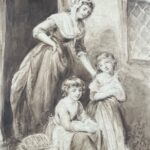
Location: National Portrait Gallery, London, Great Britain
Date: 1770
Medium: Oil on canvas
Dimensions: 11.2 x 9.4 inches
You can find more information on National Portrait Gallery website here.
In this painting, William Wilbeforce (1759-1833) is a young boy. The future philanthropist and human rights campaigner first met John Russell when the artist was visiting his aunt’s house in Wimbledon.
Russell speaks warmly of the young Wilberforce, describing him as ‘sweet, young Willberfoce’, and said he had the ‘appearance of conversion upon his soul’. It wasn’t long before he produced this painting of Wilberforce, and the pair remained acquaintances.
He studied at Cambridge University where he began a lasting friendship with the future prime minister, William Pitt. In 1780, Wilberforce became member of parliament for Hull, later representing Yorkshire. His dissolute lifestyle changed completely when he became an evangelical Christian, and in 1790 joined a leading group known as the Clapham Sect. His Christian faith prompted him to become interested in social reform, particularly the improvement of factory conditions in Britain.
Wilberforce became a leading figure in the abolition of slavery. For 18 years he regularly introduced anti-slavery motions in parliament, and in 1807, the slave trade was finally abolished, but this did not free those who were already slaves. It was not until 1833 that an act was passed giving freedom to all slaves in the British empire.
Wilberforce’s other efforts to ‘renew society’ included the organisation of the Society for the Suppression of Vice in 1802. He worked with the reformer, Hannah More, in the Association for the Better Observance of Sunday. Its goal was to provide all children with regular education in reading, personal hygiene and religion. He was closely involved with the Royal Society for the Prevention of Cruelty to Animals. He was also instrumental in encouraging Christian missionaries to go to India.
Wilberforce retired from politics in 1825 and died on 29 July 1833, shortly after the act to free slaves in the British empire passed through the House of Commons
Russell painted Wilberforce again in 1801, this time using the medium of pastel to capture his likeness, however this artwork has since been badly damaged. While sitting for Russell, Wilberforce wrote in his diary, under July 31st, labelling the artist ‘a very religious man, very high church indeed.’