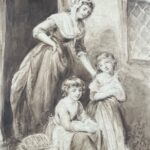
John Russell was Georgian Britain’s foremost pastellist and one of the most prolific exhibitors the Royal Academy ever knew. Across four decades he produced more than three hundred portraits that shimmer with colour and psychological insight, became Crayon Painter to King George III, and created The Face of the Moon — the most accurate lunar map drawn before photography.
Born at 32 High Street, Guildford, on 29 March 1745, Russell was the eldest child of John Russell, a prosperous bookseller who would serve five terms as the town’s mayor. Encouraged to draw from infancy, he won a Society of Arts prize at fourteen and, in 1760, was apprenticed to the celebrated pastel pioneer Francis Cotes RA. Seven formative years in Cotes’s Cork Street studio gave Russell both technical mastery and a fashionable clientele; in 1767 he opened his own practice nearby and began sending portraits to the newly founded Royal Academy.
London success coincided with a spiritual reawakening: Russell embraced Methodism in his teens and maintained a warm friendship with John Wesley all his life. On 5 February 1770 he married Hannah Faden, daughter of the Charing Cross map‑seller William Faden; the couple eventually had twelve children, several of whom appear in Russell’s affectionate domestic sketches. That same year he entered the Academy Schools, winning a silver medal, and in 1772 he published Elements of Painting with Crayons, the first English manual devoted entirely to pastel. The book codified his methods of grinding pigments, layering colour, and “sluicing” finished drawings with steam to set the surface.
By the mid‑1780s Russell was the portrait painter of choice for Britain’s intellectual and social elite. He depicted abolitionist William Wilberforce, naturalist Sir Joseph Banks, astronomer William Herschel, and a roll‑call of dukes, duchesses and scholars. Royal favour followed: in 1785 George, Prince of Wales appointed him Crayon Painter in Ordinary; on 10 February 1788 the Royal Academy elected him a full Academician; and by 1790 he held the same title for King George III and the Duke of York. Between 1769 and 1806 he exhibited 332 pastels at the Academy — an extraordinary unbroken run of thirty‑eight years.
Russell’s curiosity reached beyond the human face to the heavens. For almost twenty years he observed the Moon nightly through a Dollond refractor, measuring craters with a micrometer and redrawing each phase on blue paper. The project culminated in 1795 with The Face of the Moon, a pastel over five feet in diameter now in Oxford’s History of Science Museum, and in 1797 with a twelve‑inch revolving lunar globe, Selenographia. Contemporary astronomers hailed his map as the most precise ever made.
Technically Russell limited himself to just fourteen base pigments, blending them into hundreds of tints to achieve the velvety luminosity for which his portraits are prized. Working on tinted paper, he built form with diagonal hatching, fixed layers with gentle steam, and finished with highlights that seem to trap light beneath the wax‑rich surface — a process rivals called “brilliant beyond comparison”.
Ill‑health shadowed his final years. A severe fever in 1803 left him almost deaf, yet he continued to accept commissions and, in the spring of 1806, travelled to Hull to paint a merchant’s family. There he contracted typhus and died on 20 April 1806; three days later he was buried beneath the choir of Holy Trinity (now Hull Minster).
Today Russell’s portraits hang in the National Portrait Gallery, the Royal Collection and museums across Europe and North America, while The Face of the Moon remains a landmark in the shared history of art and science. By uniting technical precision with spiritual and intellectual curiosity, John Russell RA secured his place among Britain’s greatest eighteenth‑century artists — the man who captured both the faces of Georgian society and the face of the Moon with equal brilliance.