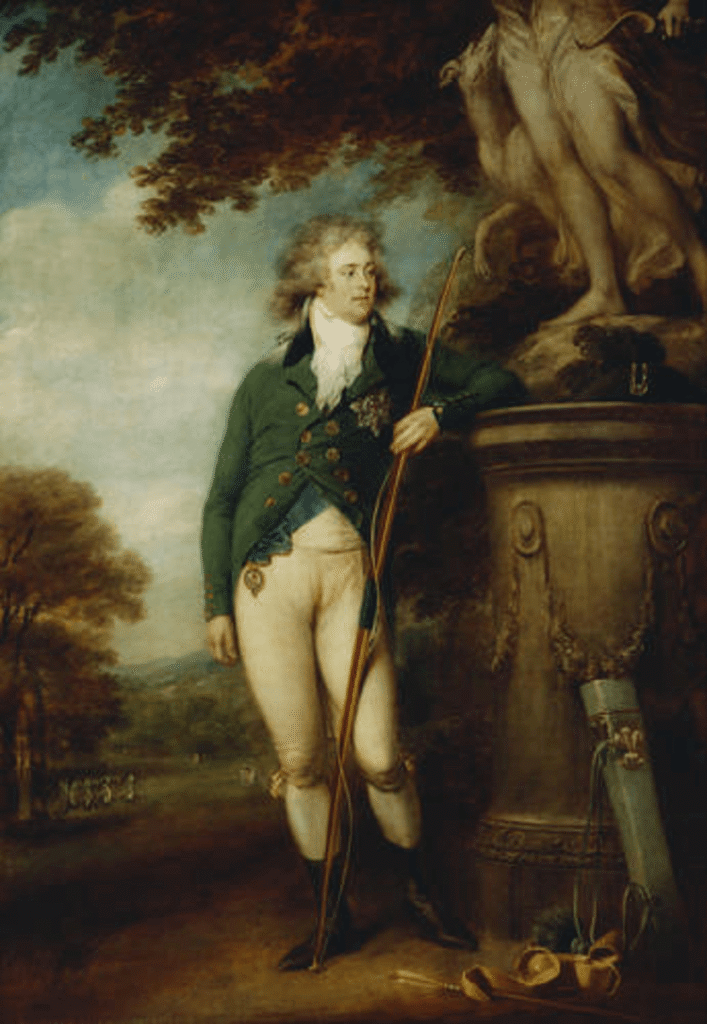
Location: Royal Collection Trust, London, England
Date: 1791
Medium: Oil on canvas
Dimensions: 9.8 x 7 inches
You can find more information on National Portrait Gallery website here.
The Prince of Wales (later George IV) was interested in his self-image. This flattering, athletic portrait was commissioned by him as a prize for a meeting of the Royal Kentish Bowmen. As president of the society, he is dressed in their green uniform. He leans on the pedestal of a statue of Diana, the classical goddess of hunting and chastity. He is not yet overly fat, yet something of his epicurean character is suggested by his pose, hair and expression.
George IV (1762 – 1830) was King of the United Kingdom of Great Britain and Ireland, and King of Hanover, from January 1820 until his death in June 1830. Long before officially taking the throne, however, he held the reins of power. From February 1811, he served as Prince Regent for his father, King George III, who had been incapacitated by severe mental illness.
As the eldest child of George III and Queen Charlotte, the prince was affectionately dubbed “Prinny” by his inner circle. He became the defining figure of the Regency era, utilizing his position to champion new forms of leisure, art, and architectural style. Among his most famous legacy projects, he commissioned John Nash to construct the exotic Royal Pavilion in Brighton and radically remodel Buckingham Palace, while tasking Jeffry Wyatville with rebuilding Windsor Castle.
While his charm and refined cultural tastes earned him the moniker “the first gentleman of England,” his dissolute lifestyle severely damaged the monarchy’s standing. George was defined by heavy financial extravagance, intense selfishness, and a dependency on personal favourites, which routinely frustrated his ministers. His private life was a constant source of public scandal, particularly his toxic relationship with his parents and his wife, Caroline of Brunswick.
Upon his accession, George went to extreme lengths to humiliate Caroline, completely excluding her from his coronation. He further damaged his own popularity by pressuring the government to introduce the highly unpopular Pains and Penalties Bill—a failed legal attempt to strip Caroline of her title and grant him a divorce.
For the majority of George’s time as regent and king, political power was managed by Prime Minister Lord Liverpool. It was Liverpool’s administration that guided Great Britain through the climax of the Napoleonic Wars and brokered the subsequent peace terms with France. Later in his reign, following Liverpool’s retirement, a politically weakened George was forced to sign off on Catholic Emancipation, despite his own fierce personal opposition to the legislation.
George IV’s final years were marked by isolation and a lack of direct heirs. His only legitimate child, Princess Charlotte, died tragically in childbirth in 1817, and his younger brother Prince Frederick passed away childless in 1827. Consequently, when George IV died in 1830, he was succeeded by his next surviving brother, King William IV.