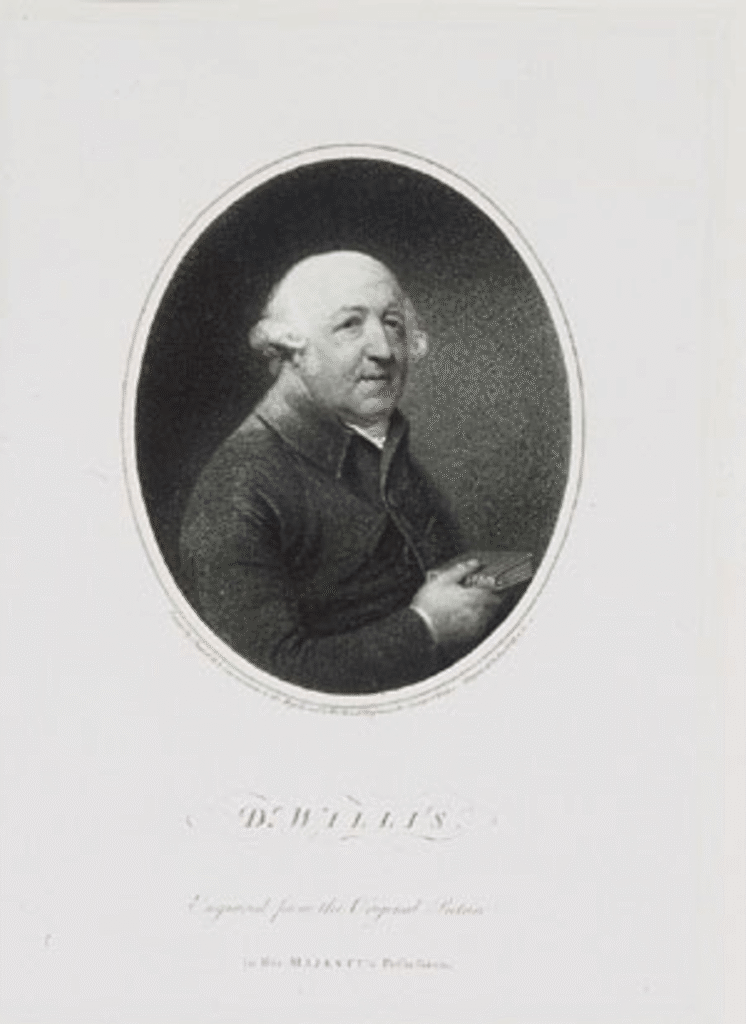
Location: Guildford Museum, Surrey, England
Date: Late 18th century
Medium: Mezzotint print
Dimensions: 10.8 x 7.8 inches
You can find more information on the Guilford Museum website here.
Dr Francis Willis (1718-1807) was an English physician and clergyman who achieved international fame for his pioneering treatments of mental illness, including curing George III.
Initially pursuing a clerical path at Oxford, Willis was ordained a priest and elected a Fellow of Brasenose College in 1740. However, his true passion lay in medicine. He obtained his medical degrees from Oxford in 1759 and began serving as a hospital physician in Lincoln.
Following an early successes with mentally ill patients, Willis began treating patients in his own home. In 1776, he moved to Greatford Hall near Bourne, Lincolnshire, establishing it as a private rural sanatorium. Breaking from the harsh institutional norms of the era, Willis encouraged his patients to perform manual outdoor work around the estate’s stables and fields. This emphasis on fresh air and physical exercise significantly aided their recovery.
Willis’s most famous challenge came in late 1788 when King George III suffered a severe episode of mental illness. The cause of the King’s madness is disputed, with theories ranging from bipolar disorder to porphyria or arsenic exposure from Georgian wigs. Nevertheless, the king’s condition deeply alarmed the nation.
Willis was called to Kew to oversee the monarch’s care. His treatment utilized standard 18th-century medical practices, including coercion, straitjackets, and skin blistering. However, Willis uniquely balanced these methods with unprecedented kindness and psychological consideration, and, on 26th February 1789, Willis announced the “entire cessation of his Majesty’s illness. The recovery turned Willis into a national celebrity, and he subsequently immortalised by John Russell, who was commissioned to take his portrait.
His newfound fame led to an advisory role in 1792 treating Queen Maria I of Portugal, who also suffered from severe madness. For the Queen, Willis recommended proper nutrition and psychotherapy over heavy medication, but this did not yield the same success as the English monarch’s.
King George III suffered a relapse in 1801 and was treated by Willis’s sons. A final, incurable relapse in 1810 left the king incapacitated until his death in 1820.
Francis Willis died in 1807, and his original Greatford Hall sanatorium closed in 1838. Today, the Lincolnshire Partnership NHS Foundation Trust honours his work through the namesake Francis Willis Unit, an inpatient facility dedicated to male mental health rehabilitation.