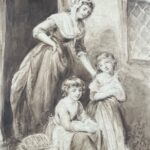
Location: Museum of Method, London, England
Date: Late 18th century
Medium: Pastel
Charles Wesley (1707–1788) was an English Anglican cleric and a principal leader of the Methodist movement. Born in Epworth, Lincolnshire, to Samuel and Susanna Wesley, he was the younger brother of Methodist founder John Wesley. His musical legacy extended through his family; he was the father of musician Samuel Wesley and grandfather of Samuel Sebastian Wesley.
Educated at Oxford University, Charles formed the “Holy Club” in 1729, a student group later joined by his brother John and George Whitefield (leading figure in 18th century protestant revivals and co-founder of Methodism). He entered the ministry in 1735 and briefly travelled with John to Georgia, America, although the pair largely failed in their conversion mission.
Following his evangelical conversion in 1738, Charles began writing the poetic hymns for which he is renowned. Though appointed curate at St Mary’s Church, Islington, in 1739, he was forced to resign due to his evangelical preaching. Barred from parish pulpits, the Wesley brothers followed Whitefield’s example and took to open-air preaching, drawing massive crowds.
From 1740, Charles and John jointly led the Methodist Revival across Britain and Ireland. They faced fierce opposition from Anglican clergy and weathered mob violence in towns like Wednesbury, Sheffield, and Devizes. In 1749, Charles married Sarah Gwynne. By 1756, his itinerant preaching slowed down, and he settled into static ministry in Bristol and later London, where he lived in Marylebone from 1771 until his death.
Wesley was an astonishingly prolific hymnwriter, penning over 6,500 hymns. His collections included Hymns on God’s Everlasting Love and Hymns on the Lord’s Supper. Marked by rich scriptural allusions, varied meters, and a strong Arminian emphasis on the universality of God’s love, his work profoundly shaped modern theology and Christian worship.
Today, his hymns are sung across Protestant denominations and the Roman Catholic Church. He composed two of the “Great Four Anglican Hymns”: “Hark! The Herald Angels Sing” and “Lo! He Comes With Clouds Descending.” In his final years, Wesley served as a prominent voice for “Church Methodists,” remaining fiercely opposed to any formal separation between Methodism and its Anglican roots.