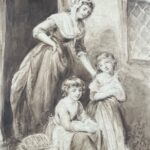
Location: National Portrait Gallery, London, Great Britain
Date: 1769
Dimensions: 50 x 38.2 inches
You can find more information on National Portrait Gallery website here.
William Dodd (1729–1777), born the son of a Lincolnshire vicar, was a Cambridge graduate whose lifelong extravagance led to his sensational downfall. After moving to London, his spendthrift habits and an impulsive marriage in 1751 to Mary Perkins, the daughter of a domestic servant, left him deeply in debt.
To stabilize his finances, Dodd took holy orders. Ordained as a priest in 1753, his eloquent, fashionable preaching style quickly won him royal favour, leading to his appointment as a royal chaplain in 1763 and tutor to Philip Stanhope, later the 5th Earl of Chesterfield. Despite accumulating lucrative church positions and winning £1,000 in a lottery, Dodd maintained a lavish lifestyle that earned him the nickname the “macaroni parson.”
Desperate for funds, in 1774 Dodd attempted to bribe the Lord Chancellor’s wife with £3,000 to secure a lucrative rectory. Exposed and publicly ridiculed, he fled abroad for two years.
Upon his return in 1777, Dodd forged a £4,200 bond in the name of his former pupil, Lord Chesterfield, to clear his persistent debts. A banker discovered the fraud, and despite Dodd’s immediate confession and efforts to pay it back, he was convicted of forgery and sentenced to death. Despite a high-profile defense campaign led by Dr. Samuel Johnson and a petition signed by 23,000 people, a pardon was refused. William Dodd was publicly hanged at Tyburn on 27 June 1777.